· 6 min read
Chair Yoga for Seniors: Beginner's Guide
A beginner's guide to chair yoga for seniors, with a class-choosing table, advice on free videos and printables, and safety notes from official NIH NCCIH pages.
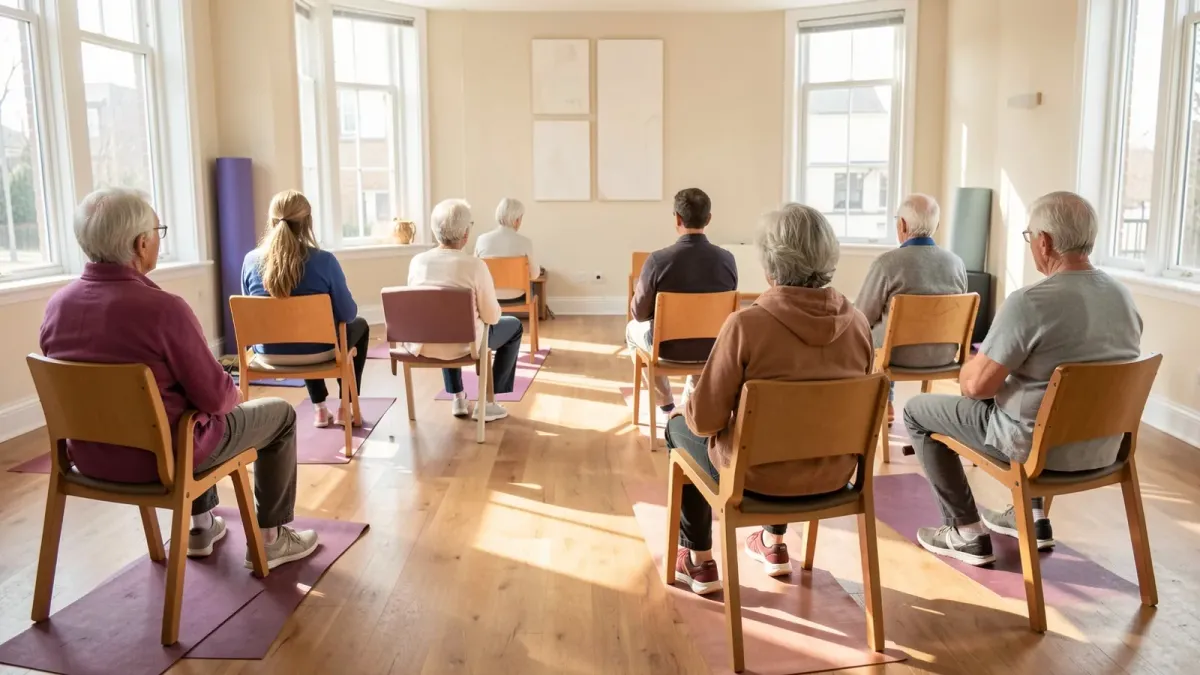
Start as a beginner, even if you have been moving for years
Chair yoga for seniors is often sold as a gentle destination, when it is really a way to begin. The better first question is not “what are the best chair yoga poses for seniors?” It is “who will watch me do this once, and tell me if my chair, my shoulders, and my pride are getting ahead of me?” We have seen able, stubborn people hurt themselves on a “simple” seated side bend because they treated the first week like a test.
The National Center for Complementary and Integrative Health, part of NIH, says yoga is generally considered a safe form of activity for healthy people when it is done properly, under the guidance of a qualified instructor, and that you can still be injured. Sprains and strains are the common problems. Older adults are advised to start with an appropriate class, such as gentle yoga or seniors yoga, and NCCIH names chair yoga as an even gentler option when mobility is limited. People with medical conditions should talk with their health care providers and the teacher, and nobody should use yoga to postpone medical care. The short official version is here: 5 things you should know about yoga. A longer discussion of older adults sits in NCCIH’s yoga for health digest.
How to choose a class before you choose a pose
Free chair yoga for seniors is easy to find, and some of it is carefully taught. A video still cannot see you. NCCIH notes that learning yoga on your own without supervision has been associated with increased risks. Use a recording or a printable chair yoga for seniors sheet as a reminder after a teacher has already shaped the movements, not as the only instruction.
When you can, start in a room with a person. Community centers, libraries, senior programs, and some studios offer seated classes. Watching one session before you join will tell you more than a flyer.
| What to ask or notice | A good sign | A weak sign | Why it matters for a beginner |
|---|---|---|---|
| The name and the actual format | “Chair yoga,” “seated,” or “gentle,” and most people stay supported | The poster says “seniors” but the room is full of standing balances on one foot | You want the class you thought you were joining |
| The teacher’s attention | They ask about injuries, replacements, dizziness, and recent surgeries | Everyone is told to “go at your own pace” and then is not watched | Modifications only work if someone sees that you need one |
| The chairs | Firm, stable, no surprise rollers; space to stand with a hold if that is offered | Soft sofas, or chairs that slide on a polished floor | The chair is your safety equipment |
| The pace | Time to sit down, time to change direction, time to rest | A continuous flow that rewards the most flexible person in the room | Seniors are not a problem to be rushed past |
| The way options are offered | “Stay here, or try this smaller version” | “If you can, take the full expression” said as a challenge | Beginners should be able to stay with the smaller version without feeling left out |
| Cost and access | A drop-in or a short series you can test | A long, prepaid package before you have tried a class | The best chair yoga for seniors is the one you can actually attend twice |
If a class is not available, a first appointment with a teacher who already works with older adults, even a short one, will still beat a random playlist. After that, a familiar recording can help you repeat what you already learned.
A first-week shape, not a training plan
Keep the goal modest: two or three short sessions, on days you already get dressed and move around the house. Use the same chair, in the same clear space. Begin sitting. Notice an ordinary breath. Move the hands, the shoulders, and the ankles in a small range. If standing with a hold is already part of how you get out of a chair safely, you may practice that with the teacher’s blessing. End by sitting and doing nothing for a minute. That last part is not a luxury. It tells you whether you are dizzy.
Do not add new movements from three different videos in the same week. The “best free chair yoga for seniors” is usually the one teacher or the one short sequence you can repeat without hunting for the next novelty. If a movement needs you to hold your breath, yank a joint, or lift off the chair to look more like the screen, it is too much for today.
Write down, in ordinary language, what you did and how you felt later the same day. Stiffness the next morning is not automatically a disaster, and it is also not a badge. New swelling, chest pain, faintness, or pain that is sharp and specific is a reason to stop and talk with a clinician, not a reason to stretch harder.
Home setup that supports a class, rather than replacing it
A dining chair, a clear patch of floor, shoes or grip socks that do not slide, and a phone within reach if you practice alone are enough. Printable chair yoga for seniors pages can live in a folder as a memory aid, with the teacher’s modifications written in the margin. They should not become a checklist you force yourself through when you are unwell.
If you live with someone, tell them you will be practicing and when you expect to be done. If you live alone, choose a time of day when you are already at your most steady, not the hour when you usually nap.
A beginner’s checklist
- I have mentioned this plan to a clinician if I have medical issues or a recent injury
- I have a way to learn from a person, not only from a screen
- My chair is firm and stable
- I can stop any movement without feeling I have failed the class
- I will repeat a small sequence before I collect new ones
- A printable or a video, if I use one, is a reminder, not my only teacher
- I will not skip medical care because I have started yoga
Questions beginners ask after they have booked, or not booked, a class
I am reasonably fit. Should I skip chair yoga and go to a regular class?
Only if a teacher who has seen you move agrees that a regular class is the right level. “Regular” classes vary wildly. Many seniors do well in a gentle or mixed class that offers a chair as an option. Starting in a seated class and then changing is a perfectly respectable path.
Are free videos a bad idea?
They are a weak first teacher and a convenient later one. If you use them, pick a teacher whose work you already trust, stay well inside a comfortable range, and stop when the camera cannot help you. “Free” does not mean “safer.”
What should I wear, and do I need a mat?
Wear clothes you can breathe in, and shoes or socks that will not slide if you stand. A mat can keep a chair from traveling on a slick floor, but it is not required for a seated session on a carpet. The chair matters more than the brand of mat.
How will I know it is helping?
You may notice that sitting and standing feel more familiar, or that a short session is a reliable way to pause in the day. Those are reasonable, modest signs. NCCIH describes possible benefits of yoga in general terms, including research related to stress, sleep, and, in older adults, measures such as flexibility or balance, but results vary and yoga is not a treatment you should substitute for care you already need. If you feel worse, or if a movement hurts in a sharp way, stop and get advice.