· 7 min read
Pilates vs Yoga: Side-by-Side Comparison
A clear Pilates vs yoga comparison for beginners, with a side-by-side table of class differences and official NIH NCCIH safety notes on practicing yoga.
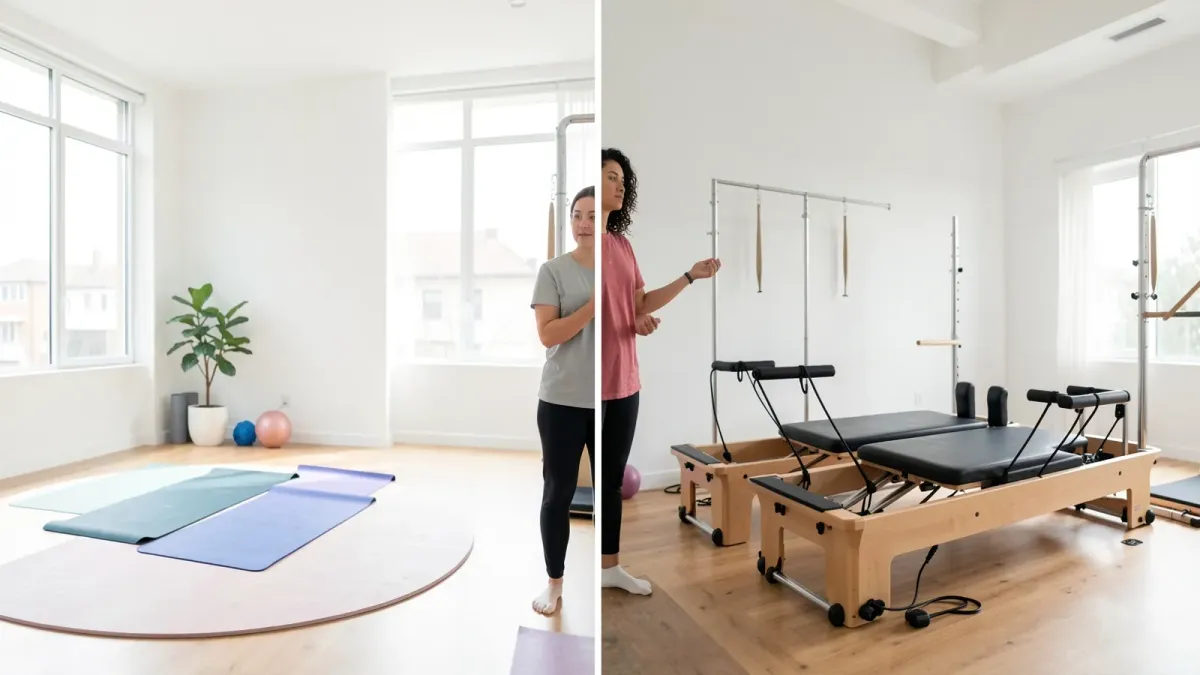
Compare a real class, not two slogans
Pilates vs yoga is a search phrase that usually wants a winner. In practice you are choosing a room, a teacher, and a way of moving for the next hour, not a personality type. We have sent neighbors to a “gentle yoga” class that turned out to be a vigorous flow, and to a “beginner Pilates” class that assumed everyone already knew the language of a reformer. The useful difference between yoga and Pilates shows up in those rooms, not in a motto.
This is a practical comparison, not a scientific ranking. The National Center for Complementary and Integrative Health, part of NIH, has reviewed yoga as a health practice and publishes plain-language safety advice: yoga is generally considered a safe form of activity for healthy people when done properly under a qualified instructor; injuries still happen, often as sprains and strains; people who are older, pregnant, or living with a medical condition should talk with their health care providers and the teacher; and yoga should not be used to delay medical care. Start with NCCIH’s 5 things you should know about yoga. Pilates is a different tradition, and we are not going to invent a matching set of government findings for it. Treat both as physical activities that deserve good instruction and the same common sense you would bring to any new class.
What a beginner is usually walking into
Yoga classes, in the forms most studios offer, typically combine postures, some attention to breathing, and, in many styles, a period of stillness or rest. Some classes are slow and held. Some are continuous and athletic. Some are mostly seated or use a chair. The word “yoga” on a timetable is not a complete description, which is why “Pilates vs yoga for beginners” only becomes answerable after you read the class name and, if you can, watch a session.
Pilates classes, in the forms most beginners meet first, typically emphasize controlled, precise movement, often with a lot of attention to the trunk and to how you arrange the ribs, the pelvis, and the breath during small ranges of motion. Mat classes use the floor and sometimes small props. Apparatus classes use spring-loaded equipment, such as a reformer, and should come with an induction, not just a cheerful wave at the machine. Here, too, the word on the door is not enough. A jumpy, choreographed mat class and a slow, closely coached private session are both called Pilates.
The difference between yoga and Pilates, then, is not that one is “spiritual” and the other is “for the core,” as internet shorthand likes to say. Plenty of yoga classes are straightforward movement classes. Plenty of Pilates teachers talk about attention and breath. The more reliable differences are the typical shapes, the equipment, the pacing, and the way a teacher corrects you.
A side-by-side table for first-time choosers
No calories, no invented study scores, no “winner.” Use this to decide what to try first, then let the actual class correct you.
| Question | Yoga, as you will often meet it | Pilates, as you will often meet it | A practical takeaway |
|---|---|---|---|
| What are you mostly doing? | A series of postures, sometimes held, sometimes linked, often including standing, seated, and lying-down work, and often a rest at the end | A series of fairly precise exercises, often on the mat or on apparatus, with frequent attention to trunk control and alignment | Both are movement classes; the shapes and the pacing will feel different |
| What might you lie or stand on? | A mat, sometimes a blanket, a wall, or a chair | A mat, or a reformer or other apparatus with moving parts and springs | If you try apparatus Pilates, get a proper introduction to the machine |
| How is breathing used? | It depends on the style: sometimes as a quiet background, sometimes as a formal rhythm tied to movement | Often cued in a specific way during an exercise | Neither approach is “better”; confusing cues are a reason to ask, not to fake it |
| What does “beginner” mean? | It should mean slower teaching and options, but some beginner yoga is still a fast flow | It should mean closer coaching and fewer assumptions, but some beginner mat classes move quickly | Ask what a first class actually looks like |
| How are you usually corrected? | Verbal cues, demonstrations, and sometimes hands-on adjustments if you have agreed to them | Often close, frequent verbal coaching, especially in a small class or a private session | You can decline hands-on adjustment in either room |
| Who might prefer it as a first try? | Someone who wants a class that may include stillness, a wider variety of postures, or a gentle or chair-based option | Someone who wants a closely coached, structured exercise class, and is curious about mat or apparatus work | Preference is allowed. You can also try both. |
| What are the shared risks? | Doing too much, too soon, or copying a deep pose from a picture | Doing too much, too soon, or fighting springs and unfamiliar machinery | Start smaller than your ego wants; tell the teacher about injuries |
What’s the difference between yoga and Pilates if you only remember one line? Yoga classes, in general, are organized around postures and, often, a broader attention practice; Pilates classes, in general, are organized around a specific exercise method and, often, closer repetition of precise movements. Individual teachers blur that line, which is a good thing when they are clear, and a confusing thing when they are not.
How to try both without turning it into a personality test
Book a beginner session of each, on different days, not back to back on a Saturday morning when you are already tired. Arrive early. Tell the teacher what hurts, what has been operated on, and what you are hoping not to do. In a yoga room, ask whether the class is a slow introductory session or a flowing one, and whether a chair or the wall is available. In a Pilates room, ask whether you will be on a mat or a machine, and whether this is a true first class.
Afterward, judge the hour in ordinary language. Could you follow? Were you allowed to do less? Did anything feel sharp? Would you go back if it were on your way home? Those questions will get you further than a debate about which method “works the core harder.” If you already train in a gym, either class can sit beside that training, as long as you do not stack two hard sessions on the same day just to decide a winner.
If you have low-back pain or another health concern, bring it to a clinician first. NCCIH notes that a substantial amount of research has looked at yoga and low-back pain, and that the evidence suggests there may be some benefit, with smaller bodies of research on some other symptoms. That is not the same as a prescription, and it is not a comparative award over Pilates. A physical therapist or a physician who knows your case may have a more specific suggestion than a comparison article can.
A checklist before you pay for a series
- I know whether the first class is yoga or Pilates, mat or apparatus, gentle or athletic
- I can visit or ask questions before buying a long package
- The teacher will hear about injuries, pregnancy, or medical conditions
- I can do a smaller version without being pushed
- I will try one of each, if I am truly deciding between them, rather than arguing from videos
- I will not drop medical care because I have started a class
Questions that come up after the first timetable look
Which is better for beginners, yoga or Pilates?
The better beginner class is the one that is actually taught as a beginner class. A careful introductory Pilates hour will beat a crowded, advanced yoga flow, and a careful gentle yoga hour will beat a fast Pilates circuit. Read the description, then go once.
Can I do both in the same week?
Many people do. Leave a little room between harder sessions, and treat the first weeks as orientation. If both leave you very sore, do less and ask both teachers to help you scale the work.
I keep seeing claims that one burns more fat or “fixes posture” faster. Are those reliable?
Treat dramatic claims with suspicion, especially when they come without a source, or with a source you cannot check. We have not invented numbers here, and you should not have to buy a class on the back of a statistic with no name. Ask what the class will actually have you do.
Do I need to be flexible or already strong?
No. You need a class that expects beginners. Flexibility and strength change slowly, when they change, and neither method is reserved for people who already look like the photograph on the website.